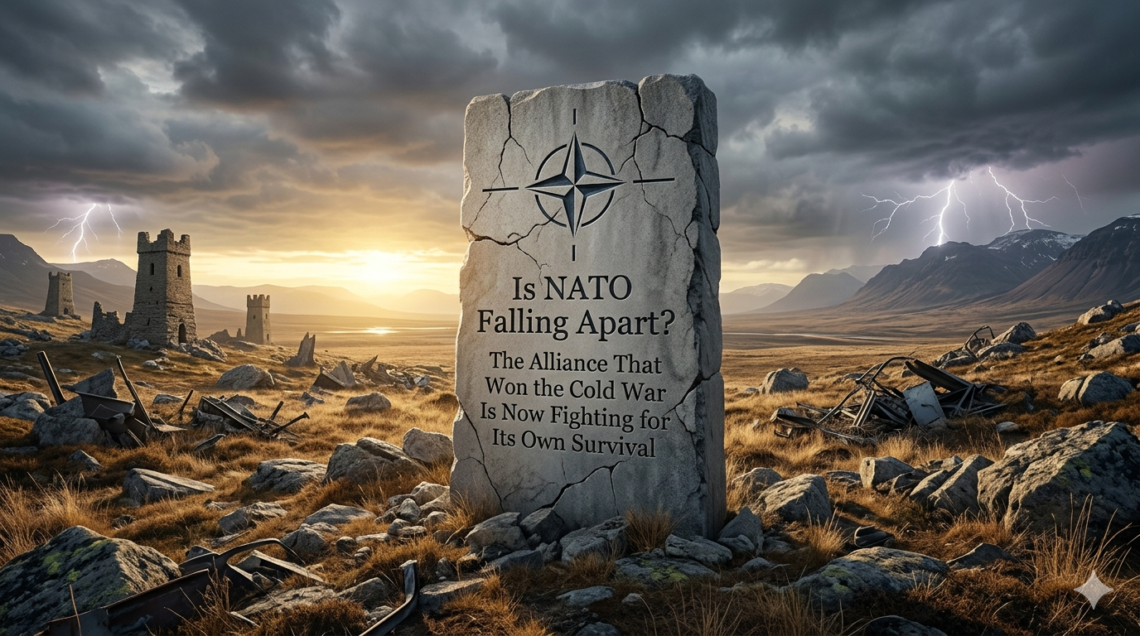
For over 75 years, NATO has been the most powerful military alliance in human history. It stopped Soviet tanks from rolling into Western Europe. It survived the Cold War. It expanded from 12 members to 32. But today, in 2026, something has shifted — and the questions being asked in Warsaw, Berlin, and Washington are no longer about Russia or China. They are about NATO itself.
Is the world’s most powerful alliance falling apart from the inside?
The Crack That Became a Fracture
The tensions in NATO are not new. Even during Barack Obama’s presidency, the “Pivot to Asia” signaled that America’s attention was drifting away from Europe. The Iraq War under Bush had already exposed deep ideological fault lines between Washington and old European powers like France and Germany.
But what is happening now is different — both in scale and in seriousness.
When Donald Trump returned to the White House in 2025, he brought with him a deeply transactional view of alliances. NATO, in his worldview, is not a sacred commitment — it is a business deal. And in his view, Europe has been a bad partner for decades.
Trump’s administration cut the U.S. share of NATO’s joint budget significantly — from around 22% down to 16% by mid-2025. Secretary of State Marco Rubio then raised the stakes further, demanding that NATO members raise their defense spending to 5% of GDP — more than double the current 2% target that most members are already struggling to meet. For smaller European economies, this demand was not just ambitious — it was seen as deliberately impossible.
The Iran War: The Match That Lit the Fire
If Trump’s budget demands were a slow burn, the Iran war was the explosion.
On February 28, 2026, the United States and Israel jointly launched military operations against Iran. Trump expected NATO allies to fall in line. They did not. European nations — including long-standing allies like France, Germany, and the UK — declined to contribute military forces to the campaign. They offered only “defensive manoeuvres” and diplomatic statements.
Trump was furious. His administration publicly framed the Iran conflict as a “test” for NATO — and declared that the alliance had failed that test. White House Press Secretary Karoline Leavitt made the statement official. The message from Washington was clear: if Europe won’t stand with America when it matters, why should America stand with Europe?
Soon after, reports emerged that Trump was actively discussing withdrawing the United States from NATO — not as a negotiating tactic, but as a genuine policy option under consideration.
The Greenland Shock: An Ally Prepared to Defend Against America
Perhaps the most surreal moment in NATO’s recent history came in early 2026, when the United States — under Trump — suggested it was prepared to use economic and military coercion to acquire Greenland from Denmark.
Denmark is a NATO member. Greenland is Danish territory. And yet, one NATO ally was threatening another.
While those specific threats have since eased, the damage was done. Denmark — a country that has fought alongside American soldiers for decades — quietly released details of how it had prepared to defend against a potential military action by its own ally. That sentence would have been unthinkable five years ago.
This is what NATO’s internal crisis looks like in 2026: not just disagreements over budgets or strategy, but one member preparing defensive plans against another.
Europe Wakes Up — But Is It Too Late?
To be fair to Europe, the continent has finally begun to respond. The shock of Russia’s invasion of Ukraine in 2022 shook many governments out of their post-Cold War complacency. Defense budgets have started rising. The conversation about “European strategic autonomy” — the idea that Europe must be able to defend itself without depending on Washington — has gone from a fringe academic debate to mainstream policy.
At the June 2025 NATO Summit in The Hague, members agreed to nonbinding commitments to raise defense spending to 5% of GDP by 2035. But the word “nonbinding” matters enormously. Spain immediately sought an exemption — and Trump attacked Spain repeatedly throughout the following year.
In February 2026, Elbridge Colby — a key figure in Trump’s defense thinking — proposed a new vision: a “back to basics” NATO that would focus exclusively on defending Europe, abandoning operations in distant regions, and demanding strict burden-sharing from all members. The idea remains stuck in disagreement between Washington and European capitals.
The Two Forces Destroying NATO From Within
Analysts point to two structural forces that are undermining the alliance at its foundation.
The first is multipolarity. The post-Cold War world, in which American power was unchallengeable, is over. China has risen. Russia, despite losses in Ukraine, remains a nuclear power with global reach. The United States can no longer afford — politically or economically — to be the sole guarantor of global security. America is recalibrating, and Europe is caught unprepared.
The second is sovereigntism. Both in the United States and across Europe, nationalist movements are gaining ground. These movements are suspicious of international institutions, skeptical of shared obligations, and politically rewarded for putting their own nation first. Trump embodies this in America. Similar currents are visible in Italy, Hungary, France, and beyond.
When the leader of the most powerful NATO member openly questions whether the alliance is worth maintaining, and when European governments are increasingly pulled by nationalist politics, the shared vision that built NATO begins to dissolve.
So Is NATO Actually Falling Apart?
The honest answer is: not yet — but it is being fundamentally transformed, whether its members want it to or not.
NATO as a formal institution still exists. Its 32 members still have treaty obligations. Article 5 — the collective defense clause — is still on paper. But the political will that makes those words meaningful is eroding.
What is clearly happening is this:
- The trust between the US and Europe is at its lowest point since NATO’s founding
- The operational unity of the alliance has been openly questioned, most recently over Iran
- The financial model of the alliance — heavy US subsidy, light European contribution — is no longer politically sustainable in Washington
- And for the first time, a US president is actively discussing withdrawal from the alliance
NATO may not collapse with a single dramatic announcement. It may instead hollow out slowly — with the US reducing its commitments, Europe building parallel structures, and the alliance becoming a shell of what it once was.
What This Means for the Rest of the World
For Russia, NATO’s internal divisions are a gift. Vladimir Putin’s strategic gamble — that Western unity would eventually fracture — may be proving correct, not because of anything Russia did in 2026, but because of what America did.
For China, a weakened NATO means a weakened West — and more room to maneuver in Asia, the Pacific, and beyond.
For countries like India, a world without reliable US-led security frameworks means more complexity, more unpredictability, and more need for independent foreign policy.
And for the Global South, the spectacle of the world’s most powerful alliance tearing itself apart over money and political pride raises a deeper question: if the West cannot hold its own alliances together, what does Western-led “rules-based order” actually mean?
The Bottom Line
NATO was built on a simple idea: an attack on one is an attack on all. For 75 years, that idea held — through crises, disagreements, and wars.
Today, that idea is under its most serious threat — not from Russia’s missiles or China’s navy, but from political forces within the alliance itself.
Whether NATO adapts, transforms, or slowly fades, one thing is certain: the world that emerges on the other side will look very different from the one we have known since 1949.
Sources: Al Jazeera, Associated Press, 19FortyFive, University at Buffalo, Gulf News, NYC Foreign Policy Association


