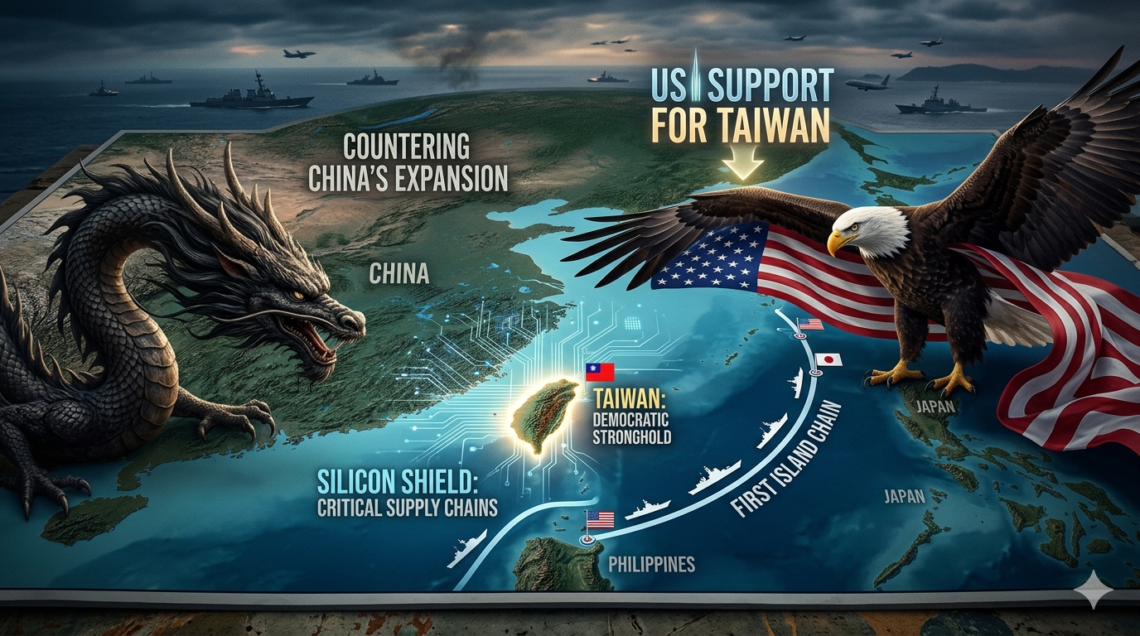
In the high-stakes game of global geopolitics, a small island in the Western Pacific has become the center of a brewing storm. Taiwan, a self-governed democratic island of 23 million people, finds itself at the heart of the intense rivalry between the world’s two biggest superpowers: the United States and China.
While Washington officially maintains a policy of “strategic ambiguity,” it has steadily intensified its political and military backing for Taipei. But why exactly is a small island thousands of miles away so vital to American national security?
Here are the 4 critical reasons why the USA must support Taiwan to counter China’s global ambitions.
1. The “Silicon Shield” (Global Tech Monopoly)
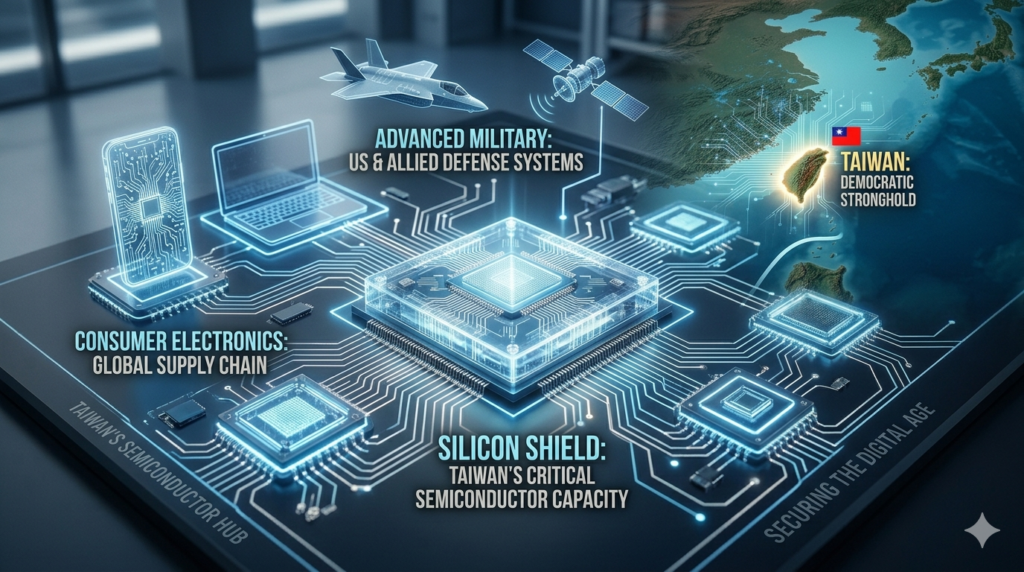
The most immediate, real-world reason is electronic and economic. Taiwan is the undisputed hub of the world’s semiconductor industry.
- TSMC’s Dominance: Taiwan Semiconductor Manufacturing Company (TSMC) produces over 90% of the world’s most advanced microchips. These chips power everything from your everyday smartphones and AI servers to advanced U.S. military hardware, including F-35 fighter jets and satellite systems.
- The Threat: If China takes control of Taiwan, Beijing would gain an absolute monopoly over global tech supply chains. A conflict or blockade in the Taiwan Strait could freeze global manufacturing, triggering a massive worldwide economic recession.
2. The Military Checkpoint (The First Island Chain)
From a naval and military perspective, Taiwan is a strategic fortress. It is the lynchpin of the “First Island Chain”—a network of islands stretching from Japan to the Philippines.
- Containing the Dragon: This island chain effectively keeps the Chinese military (PLA) contained close to its mainland.
- Pacific Domination: If Beijing absorbs Taiwan, it breaks this barrier. China could station its advanced submarines, long-range missiles, and naval fleets on Taiwan’s eastern coast. This would give China direct, deep-water access to the Pacific Ocean, directly threatening U.S. territories like Guam and pushing American influence out of Asia.
3. The Credibility of American Alliances
The U.S. does not fight alone; its global power relies heavily on a network of trusted allies like Japan, South Korea, Australia, and the Philippines.
- Under the Taiwan Relations Act, the U.S. is legally bound to provide Taiwan with defensive weapons to protect itself.
- The Domino Effect: If Washington stands by and allows China to forcefully take Taiwan, America’s “security guarantees” would lose all credibility. Regional allies might feel abandoned, forcing them to either develop their own nuclear weapons for survival or align with Beijing, effectively ending decades of American leadership in the Indo-Pacific.
4. Ideology: Democracy vs. Authoritarianism
Taiwan is a shining example of a prosperous, free-market, liberal democracy.
- It serves as a direct, living counter-narrative to the Chinese Communist Party’s (CCP) claim that Western-style democracy cannot work in Chinese culture.
- For the U.S., protecting Taiwan is a moral stance. Allowing an authoritarian superpower to forcefully crush a thriving democratic neighbor would signal a dangerous shift toward a world order where “might makes right,” destroying international laws established after World War II.
⚠️ The Ultimate Risk: The Threat of WWIII
While the strategic arguments for supporting Taiwan are rock-solid, critics and anti-war analysts warn of a dangerous flip side. They argue that backing Taiwan too aggressively could push China into a corner, triggering a direct, full-scale military conflict. In a worst-case scenario, a war over Taiwan could escalate into a catastrophic nuclear confrontation between two global giants.
Conclusion: A Volatile Balance
Supporting Taiwan is not just about defending a small island; it is about maintaining the global balance of power, protecting the tech that runs our daily lives, and standing up for democratic values. As Washington continues to approve multi-billion dollar arms deals to turn Taiwan into an un-swallowable “porcupine,” the world watches anxiously. The fate of Taiwan may very well decide who leads the 21st century.
What is your take?
Should the U.S. risk a direct war with China to protect Taiwan, or should it stay out of the conflict? Let us know your thoughts in the Comments below, and don’t forget to Share this article with fellow geopolitics enthusiasts!


