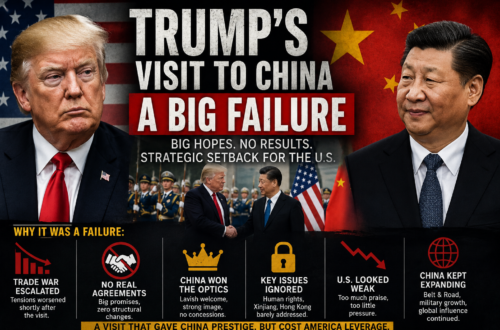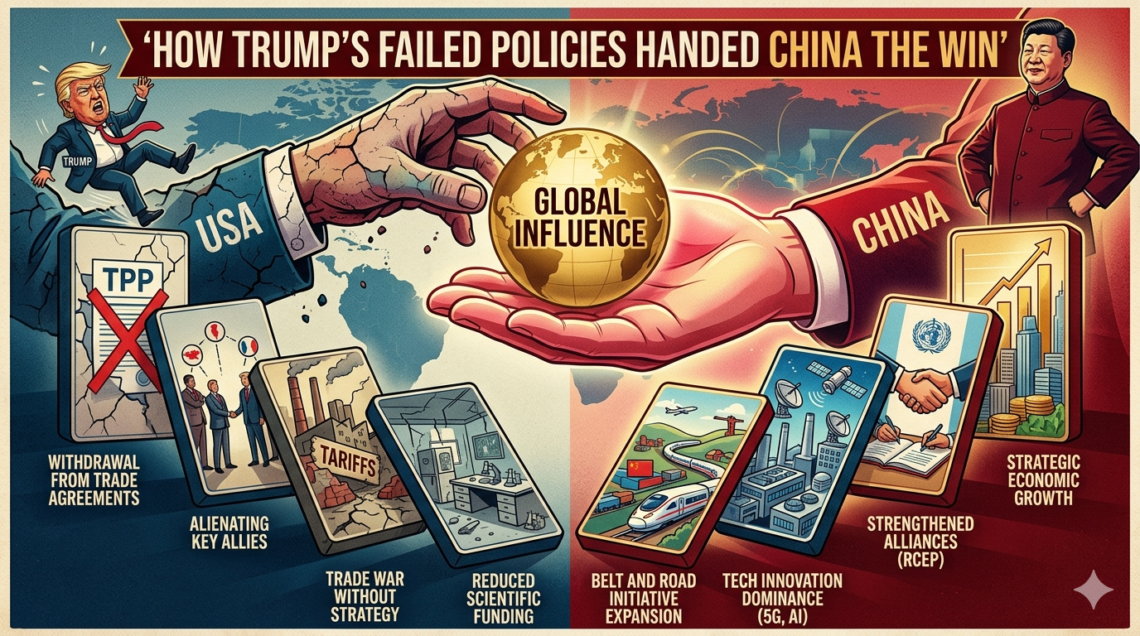
He promised to crush China economically. Instead, his tariff wars pushed American allies away, forced Beijing to adapt — and left China posting a record trillion-dollar trade surplus by end of 2025.
| $1.19T China’s trade surplus in 2025 — a record high | 127% Peak US tariff on Chinese goods, May 2025 | +29% China–Indonesia trade growth in 2025 | 6.6% China’s export growth in Dec 2025 (yr-on-yr) |
China–Indonesia trade growth in 2025
When Donald Trump returned to the White House in January 2025, he came armed with the same old weapon: tariffs. He once called them “the most beautiful word in the dictionary.” And in the months that followed, he swung that weapon wildly — slapping duties on China, Canada, Mexico, the EU, and dozens of other trade partners — apparently convinced that economic pain abroad would translate into gains at home. It didn’t work the first time. It hasn’t worked the second time either. And along the way, the biggest beneficiary has been the country he most wanted to hurt: China.
“China is eating our lunch, and the American people are paying for it.” — Senate Banking Committee Minority Staff Report, October 2025
The tariff escalation
Within weeks of taking office, Trump signed orders imposing a 10% tariff on all Chinese imports — a figure that ballooned to a staggering 127% by May 2025, covering 100% of Chinese goods entering the United States. In theory, this was supposed to choke Beijing’s economy. In practice, it did something quite different: it forced China to stop depending on America.
Beijing had seen this coming. During Trump’s first term, Chinese exporters had already begun diversifying their markets — slowly at first, then with urgency. By 2025, that shift had become a flood. Chinese trade to Indonesia grew by 29%, to Vietnam by 23%, and to India by 19.4%, according to supply chain tracker Project 44. Meanwhile, China’s exports to ASEAN nations rose over 8% and to EU countries nearly 15%, even as US-bound shipments declined. The net result? China’s overall exports grew 5.4% in 2025, and it posted a trade surplus of $1.189 trillion — the first time any country had ever crossed the trillion-dollar mark. That’s a surplus roughly equal to the entire GDP of Saudi Arabia.
Alienating allies, not adversaries
Perhaps the most self-defeating aspect of Trump’s strategy was its lack of focus. Rather than building a coalition of allies to pressure China multilaterally — which is what economic strategists had long recommended — Trump chose to fight everyone at once. He imposed tariffs on Canada and Mexico, his closest trading partners and the co-signatories of his own USMCA deal. He threatened the EU. He fought with South Korea, Japan, and India. Every tariff against an ally was a gift to China: it drove wedges into the very alliances that could have contained Beijing’s ambitions.
American foreign policy analysts at the American Enterprise Institute warned as early as mid-2025 that US tariffs on other countries were actively helping China capture more of the American market indirectly — through transshipment and supply chain rerouting. Trump’s broad, indiscriminate approach had the paradoxical effect of making the global trading system more accommodating to China, not less.
A timeline of missteps:
- Feb 2025 – Trump imposes 10% tariffs on China; simultaneously picks a fight with Canada and Mexico — breaking his own USMCA trade deal.
- Mar 2025 – 25% tariffs on all steel and aluminum imports worldwide, alienating traditional US allies in Europe and Asia.
- Apr 2025 – Trump announces sweeping reciprocal tariffs on virtually all countries. Markets go into shock. The dollar weakens.
- May 2025 – US tariffs on China peak at 127%. Both countries announce a partial truce — with the US suspending its 34% reciprocal tariff for 90 days. America blinks first.
- Nov 2025 – China’s cumulative trade surplus crosses $1 trillion for the first time in history — mid-year, not even waiting for December.
- Jan 2026 – Full-year 2025 numbers confirm it: China’s surplus hits $1.189 trillion. Its exports grew despite US pressure. Its trading relationships are more diversified than ever before.
What China figured out
Here is the uncomfortable truth at the heart of this story: China adapted, and America didn’t. While Trump’s administration oscillated between escalation and sudden truces — imposing tariffs, pausing them, reinstating them — Chinese manufacturers quietly built new supply chains across Southeast Asia, set up production hubs in Vietnam and Indonesia, and expanded their customer base across Africa and Latin America. As HSBC’s chief Asia economist Fred Neumann put it in early 2026, China’s economy remains “extraordinarily competitive,” driven by rising technological sophistication and the hard lessons of surviving a decade of US pressure.
The irony is sharp. Trump’s trade war was supposed to make China weaker and more dependent. Instead, it made China more resilient, more globally connected, and — by the end of 2025 — richer than ever on paper. Meanwhile, American consumers paid higher prices. American farmers watched their export markets shrink as China imposed retaliatory tariffs on US agricultural products. American importers sat on frontloaded inventories and crunched the numbers on balance sheets hit hard by duties.
“To now, American policy pushed China to transship through other countries. In late 2025 and 2026, the US may help China capture more of our market directly.” — American Enterprise Institute, August 2025
The bigger picture
None of this means that the US-China relationship isn’t genuinely complex, or that concerns about unfair trade practices, intellectual property theft, or technology transfer are invalid. They are valid. But there is a difference between a coherent long-term strategy to address these issues — one that builds alliances, strengthens domestic industries, and creates leverage — and a chaotic tariff war waged through executive orders, walked back within days, reimposed weeks later, and undermined by simultaneous fights with every other major economy on earth.
Trump’s “trade wars are good, and easy to win” turned out to be neither. They were messy, expensive, and — for America — largely unsuccessful. China enters 2026 with a record trade surplus, a more diversified export base, deeper ties to the Global South, and a hard-won confidence in its own economic resilience. If that was the goal, the policy succeeded brilliantly. It just succeeded for the wrong side.
Sources: Senate Banking Committee Minority Staff Report (Oct 2025); Reuters / Yahoo Finance (Jan 2026); Peterson Institute for International Economics; American Enterprise Institute; Project 44 supply chain data; CNBC (Dec 2025); PIIE tariff tracker.